PREDICT
Prediction Market Infrastructure
Market infrastructure for collective intelligence.
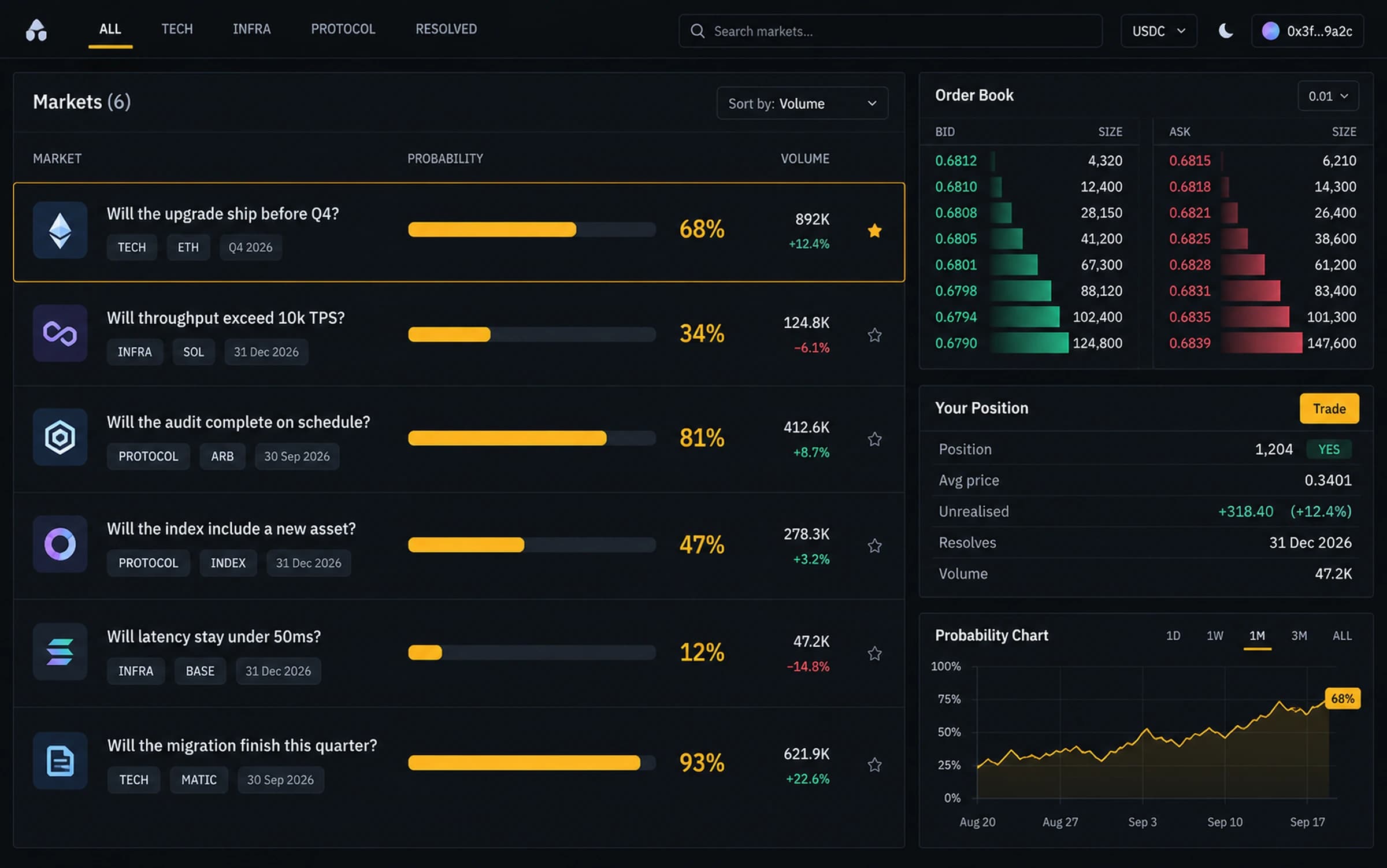
Launch markets where the price means something from the first trade and settlement is mechanical rather than argued.
- Matching engine
- AMM backstop
- Oracle committee
- Dispute game
- Deterministic replay
Market creation, order books, liquidity, oracle-driven settlement and analytics — the full stack behind a prediction market, not just the trading screen.
What the product is built around.
PREDICT treats a market as a contract between a question, a resolution source and a settlement procedure — all fixed at creation. Liquidity is seeded programmatically so price is meaningful from the first trade, and disputes follow a defined escalation path rather than a support ticket.
Resolution decided before trading
The source, the exact resolvable statement and the dispute path are bound at market creation, so settlement is mechanical rather than argued.
Liquidity from block zero
An AMM backstop quotes alongside the order book, so early markets have a real price instead of a wide empty spread.
Prices as a data product
Aggregate probabilities, volume-weighted confidence and calibration history are exposed as a feed, not just rendered on a page.
What makes this hard.
A prediction market is easy to prototype and hard to operate. The trading interface is the visible tenth of it. The other nine tenths are market definition that cannot be gamed, liquidity that exists before the first trader arrives, and a settlement process that produces one defensible answer when real money is on it.
- 01
Ambiguous market questions make settlement contestable after the fact
- 02
New markets have no liquidity, so the first trader gets a meaningless price
- 03
A single oracle source is a single point of manipulation
- 04
Resolution disputes have no structured path and become social conflicts
- 05
Thin books produce prices that are noise rather than information
What the system does.
PREDICT binds the question, the resolution source and the settlement procedure at market creation, so resolution is mechanical rather than contested afterwards. An AMM backstop quotes alongside the order book from block zero, which gives early markets a real reference price. Matching runs off-chain for latency against an append-only order log, and settlement happens on-chain for finality.
Markets cannot open without a resolvable statement and a source-silent fallback
Threshold oracle attestation with escalation to committee on disagreement
AMM backstop so the first trade has a meaningful price
Order log makes fills independently verifiable despite off-chain matching
Integer share accounting so payouts sum exactly to collateral held
PREDICT, as working interface.
Rendered UI, not a mockup — real tables, charts, filters and states. Try ⌘K for the command palette.
Open interest
$9.84M
Active markets
214
24h volume
$1.42M
Brier score
0.141
Market
Will regional EV sales exceed the 2026 baseline projection?
$0.64
64% implied
$0.36
36% implied
YES price history
YES price · 30DOrder book — YES
Market definition
- Market ID
- mkt_ev_baseline_26
- Outcomes
- YES / NO
- Resolution source
- Published reference dataset
- Resolver
- 3-of-5 oracle committee
- Close
- 2026-12-31 23:59 UTC
- Dispute window
- 48h post-resolution
- Fee
- 0.20% taker · 0.05% rebate
- Status
- Open · trading
Market discovery
| Market | Category | YES | 24h Δ | Volume | Open int. | Trend | Closes |
|---|---|---|---|---|---|---|---|
| Will regional EV sales exceed the 2026 baseline projection?mkt_ev_baseline_26 | Sample · Index | 62.4¢ | +4.8¢ | $284K | $1.42M | 99 days | |
| Will the sample logistics index close above 180 this quarter?mkt_logistics_180 | Sample · Index | 38.1¢ | −2.2¢ | $196K | $1.08M | 184 days | |
| Will the reference benchmark suite exceed a 90% score?mkt_bench_90 | Sample · Technology | 71.8¢ | +6.1¢ | $412K | $2.14M | 42 days | |
| Will sample network throughput pass 8,000 TPS sustained?mkt_tps_8k | Sample · Networks | 44.6¢ | +0.4¢ | $148K | $862K | 99 days | |
| Will the demo reference rate move at the next scheduled review?mkt_ref_rate | Sample · Index | 84.2¢ | +1.8¢ | $628K | $2.86M | 6 days | |
| Will sample launch cadence exceed 140 for the period?mkt_cadence_140 | Sample · Technology | 56.9¢ | −1.1¢ | $92K | $488K | 184 days |
6 of 214 active markets · prices shown for illustration and do not reflect any real market
Your position
- Side
- YES
- Shares
- 18,400
- Avg entry
- 54.2¢
- Mark
- 62.4¢
- Unrealised
- +$1,508.80
- Max payout
- $18,400.00
- Max loss
- $9,972.80
- Break-even
- 54.2¢
Liquidity depth
±10¢ of mid- Book depth — bids$67.1K
- Book depth — asks$63.7K
- AMM backstop$182.4K
- Maker incentive budget$8.4K / $20K
- Slippage @ $25K1.8%
Calibration
predicted vs actualSettlement queue
- mkt_index_q3 — under reviewDispute
1 dispute filed · escalated to 5-member committee · 31h remaining
- mkt_ref_hold — finalisedT+48h
Dispute window closed with no challenge · $412K paid to 1,842 holders
- mkt_report_q3 — resolved NOT+2h
3 of 5 attesters agreed · dispute window open until 14:20 UTC
- mkt_approval_step — awaiting sourceT+0
Reference dataset has not published · market held, not force-resolved
- mkt_ref_rate — closing soonT−6h
Trading halts at close · no new orders accepted after 23:59 UTC
Oracle committee agreement
mkt_report_q3- Market
- Agreed
- Abstained
- Disagreed
Interface states
UI statesNo markets in this category
Create the first market or widen the filter to see adjacent categories.
Create marketEmpty stateOrder rejected
Limit price crossed the slippage bound you set. The order was not partially filled — nothing was executed.
How it is put together.
Matching runs off-chain for latency; settlement runs on-chain for finality. The boundary between them is the only place trust is required.
- 01
Trading Interface
Order entry, book depth, payoff preview, position and resolution views.
- Next.js
- React
- WebSocket
- 02
Market API
Market definitions, discovery, order intake, risk checks and analytics.
- Node.js
- REST
- GraphQL
- 03
Matching Engine
Price-time priority book per outcome with deterministic replay from the order log.
- Rust
- In-memory book
- Event log
- 04
Liquidity Layer
AMM backstop quoting against the book plus maker incentive accounting.
- Rust
- Fixed-point maths
- 05
Oracle & Settlement
Committee attestation, dispute window, escalation and payout calculation.
- Solidity
- Multi-sig attestation
- Dispute game
- 06
Blockchain
Collateral custody, outcome tokens and final payout distribution.
- EVM
- Base
- Indexer
What the product does.
The capability set the demonstration is built around.
Market creation
Structured market definitions with resolution source, outcome set and dispute window.
Market discovery
Category browse, trending signals, closing-soon surfacing and probability movers.
Order books
Central limit order book per outcome with maker rebates and price-time priority.
Trading interface
Limit and market orders, position sizing, payoff preview and slippage bounds.
Liquidity
AMM backstop alongside the book with configurable depth and incentive schedules.
Settlement
Oracle-driven resolution with a dispute window and escalation to committee review.
Admin & analytics
Market operations console plus calibration, volume and participation analytics.
Challenges, and the MaatX approach.
The problems that actually decide whether a system like this survives production — and how we address each one.
An ambiguous question makes settlement unresolvable
Markets require a resolvable statement, a named source and an explicit 'source silent' fallback before they can be created. A market that cannot state how it resolves cannot open.
A single oracle is a single point of manipulation
Resolution requires a threshold of independent attesters with each attestation recorded against the source it cites. Disagreement escalates to a committee instead of taking the majority quietly.
New markets have no price because they have no liquidity
An AMM backstop quotes both sides from creation with bounded depth, so the book has a reference price on the first trade and organic makers can improve on it.
Off-chain matching means trusting the operator
Every order is written to an append-only log before matching. The book state is a deterministic replay of that log, so any participant can independently verify the fills they received.
Payout maths must be exact across thousands of holders
Settlement uses integer share accounting with a documented rounding policy and a residual account, so distributed payouts always sum exactly to collateral held.
The stack behind it.
Matching engine
- Rust
- Tokio
- Price-time priority book
- Event sourcing
- Deterministic replay
- Fixed-point arithmetic
- Lock-free ring buffer
Contracts & settlement
- Solidity
- Foundry
- ERC-1155 outcome tokens
- Multi-sig attestation
- Dispute game
- Slither
- Property-based tests
Liquidity & risk
- AMM backstop quoting
- LMSR pricing
- Maker incentive accounting
- Position limits
- Collateral checks
- Circuit breakers
Backend & APIs
- Node.js
- TypeScript
- REST
- GraphQL
- WebSocket
- Idempotency keys
- Rate limiting
Data
- PostgreSQL
- ClickHouse
- Redis
- Kafka
- Double-entry ledger
- Reorg-safe indexer
Frontend
- Next.js
- React
- TypeScript
- Tailwind CSS
- Canvas depth chart
- WebSocket streams
- Optimistic order state
Infrastructure
- Docker
- Kubernetes
- Terraform
- OpenTelemetry
- Structured audit logs
- Blue-green deploys
How it grows with the business.
The same system at three stages. Most products should not start at the third — but the architecture should not have to be thrown away to get there.
Binary markets with a single resolution source and simple settlement.
- Binary YES/NO markets
- AMM-only liquidity
- Single attester resolution
- Portfolio and position views
Order book, incentives and a real dispute process.
- Central limit order book with maker rebates
- AMM backstop alongside the book
- Threshold oracle committee and dispute window
- Market analytics and calibration tracking
Market infrastructure others build on.
- Scalar and multi-outcome markets
- Published probability feed as a data product
- Institutional order-entry API
- Reputation-weighted attesters with stake at risk
Where it could go next.
Directions this system would extend into.
- 01
Scalar and multi-outcome markets beyond binary questions
- 02
Published probability feed with calibration history as a data product
- 03
Reputation-weighted oracle committees with stake at risk
- 04
Combinatorial markets for conditional and correlated questions
- 05
Institutional API with FIX-style order entry

Building a market that has to price meaningfully and settle mechanically, including when it is disputed?
We built PREDICT to work through exactly this. Tell us where you are and we will tell you what we would do differently for your constraints.