The stack, and the standards it is held to.
Tools matter less than how they are used. This is what we build with, and the engineering standards we apply regardless of stack.
- AI
- Blockchain
- Software
- Data
- Automation
- Infrastructure
Engineering capabilities.
Four areas that overlap on most projects. The interesting work is where two of them meet.
AI
Systems that reason over your data and act on it.
- LLMs
- Agents
- RAG
- MCP
- OpenAI
- Anthropic
- Embeddings
- Vector search
- Rerankers
- Evaluation
- Automation
Blockchain
On-chain logic plus the operational layer around it.
- Solidity
- EVM
- Solana
- Foundry
- Hardhat
- Viem
- DeFi
- RWA
- Indexing
- Oracles
- Multichain
Software
Product engineering that holds up as it grows.
- TypeScript
- Python
- Rust
- React
- Next.js
- Node.js
- FastAPI
- REST
- GraphQL
- WebSockets
- Tailwind
Infrastructure
The part that decides whether any of it stays up.
- AWS
- GCP
- Vercel
- Docker
- Kubernetes
- Terraform
- PostgreSQL
- Redis
- Kafka
- ClickHouse
- Distributed Systems

AI that does more than chat.
Most AI failures are not model failures. They are retrieval failures, permission failures, or a side effect that ran twice.
- 01
Data
Source systems, documents, events and product telemetry.
- 02
Context
Structural parsing and chunking that preserves meaning.
- 03
Retrieval
Hybrid search, reranking and entitlement filtering.
- 04
Reasoning
Constrained generation grounded in retrieved evidence.
- 05
Tools
Typed, permissioned, idempotent side effects.
- 06
Agents
Durable execution with plans, memory and approval gates.
- 07
Evaluation
Groundedness, task success and regression gates on change.
- 08
Production
Cost budgets, tracing, replay and rollback.

Blockchain beyond the smart contract.
A reorg that corrupts balances, a stale oracle, a retry that submits twice. These are the failures that cost money, and none of them live in the contract.
- 01
Application
Product surfaces with optimistic state and clear failure paths.
- 02
APIs
Idempotent mutations, auth and request signing.
- 03
Business Logic
Rules, risk checks and policy evaluation.
- 04
Smart Contracts
Audited, role-gated, upgrade-aware on-chain logic.
- 05
Indexing
Reorg-safe cursors and deterministic state reconstruction.
- 06
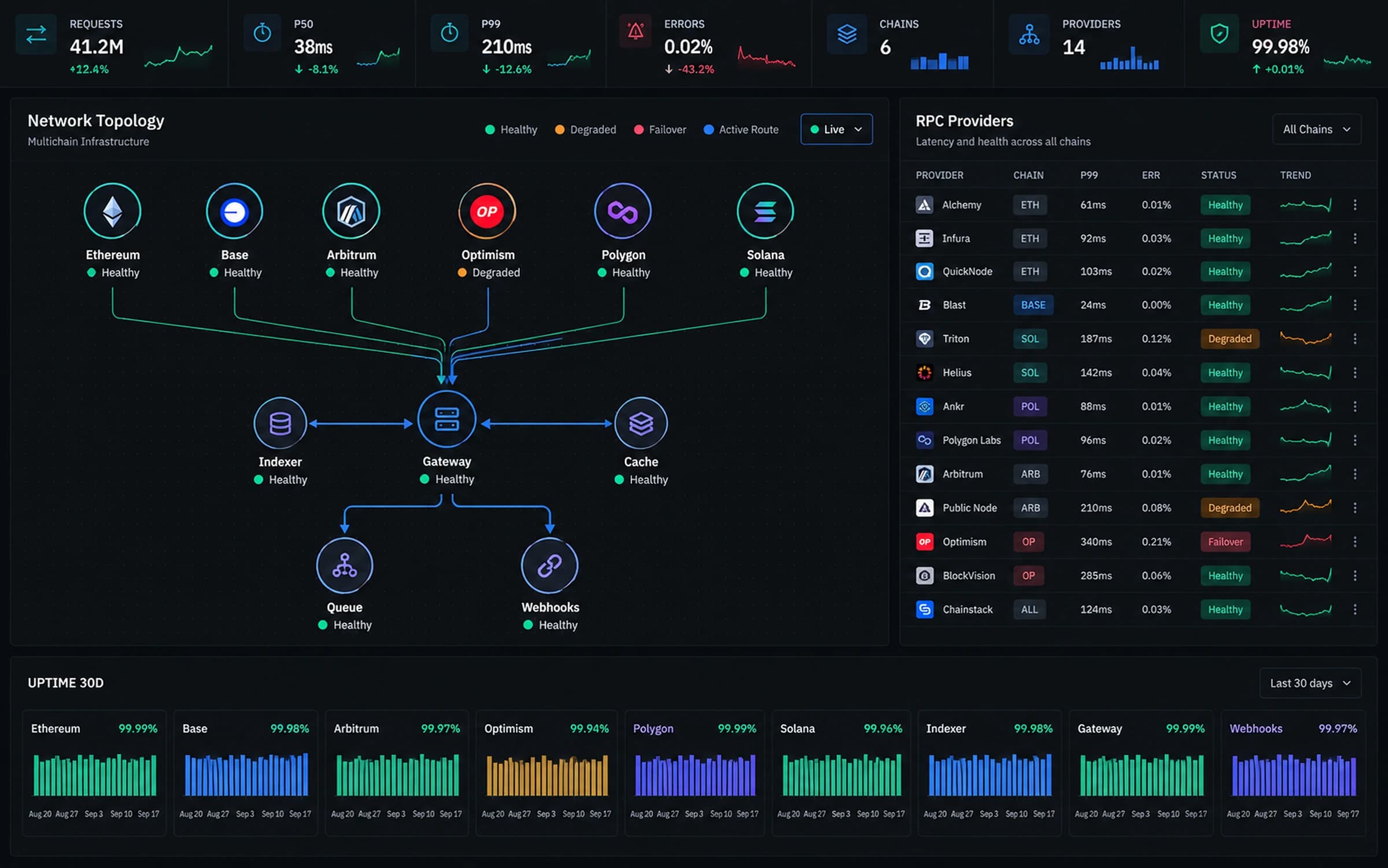
Blockchain
EVM and Solana execution with multi-provider access.
- DeFi
- RWA
- Payments
- Multichain
- Blockchain Intelligence

Software engineered to be operated, not just shipped.
- 01
Product definition
What the system must do, and what happens when it does not.
- 02
Architecture
The decisions that are expensive to reverse, made deliberately.
- 03
Data model
Schemas and contracts designed to survive the next three features.
- 04
APIs
Typed contracts with explicit error semantics and idempotency.
- 05
Application
Product surfaces that handle every state, not just the happy path.
- 06
Infrastructure
Containerised, reconciled, progressively deployed.
- 07
Observability
Traces, logs and SLOs so production behaviour is diagnosable.
- 08
Scale
Performance, cost and reliability driven by what production shows.
What makes software expensive later is decided early: the data model, the API contract, the trust boundaries. We spend the time where reversal costs most.
Depth
- TypeScript
- Python
- Rust
- APIs
- Databases
- Cloud
- CI/CD
What keeps it running.
The layer that decides whether everything above it stays available, diagnosable and affordable.
Languages
- TypeScript
- Python
- Rust
- Solidity
- SQL
AI platform
- OpenAI
- Anthropic
- Open-weight models
- MCP
- pgvector
- Rerankers
- Evaluation harnesses
Chains & tooling
- Ethereum
- EVM L2s
- Solana
- Foundry
- Hardhat
- Viem
- Slither
Application
- React
- Next.js
- Node.js
- FastAPI
- REST
- GraphQL
- WebSockets
Runtime
- Docker
- Kubernetes
- Serverless
- Edge runtimes
- AWS
- GCP
- Vercel
Delivery
- CI/CD
- Infrastructure as code
- Terraform
- Progressive rollout
- Health gates
- Automatic rollback
Observability
- OpenTelemetry
- Structured logs
- Traces
- Metrics
- SLOs & error budgets
- Cost attribution
Data
- PostgreSQL
- ClickHouse
- Redis
- Kafka
- pgvector
- Object storage
- Double-entry ledgers
Security
- Secret management
- RBAC
- Audit logging
- Dependency review
- Threat modelling
- Idempotency keys
Scale
- Caching layers
- Queues & back-pressure
- Partitioning
- Read replicas
- CDN
- Load testing
How we decide what good looks like.
These apply to every project regardless of language, chain or model. They are the part that does not change.
- 01
Correctness before cleverness
A simpler design that is obviously right beats a sophisticated one that needs a diagram to verify. Complexity has to earn its place.
- 02
Failure is the design input
Retries, timeouts, partial failure, reorgs, stale data and back-pressure are considered before the happy path is written.
- 03
Idempotency everywhere it matters
Any operation with a side effect carries a key. Retries are normal; duplicate effects are a defect.
- 04
Observability is part of the feature
If production behaviour cannot be diagnosed from the outside, the work is not finished.
- 05
Security at the boundary
Input validation, authorisation and secret handling live at trust boundaries, not scattered through business logic.
- 06
Accessible by default
Semantic markup, keyboard paths, visible focus and reduced-motion support are baseline, not a later pass.
We pick the boring option unless the interesting one solves a real problem. A new dependency, a new language or a new architecture pattern has to be worth the cost it adds for everyone who maintains the system afterwards — which is usually not us.

Have an architecture problem?
Bring us the constraints. We’ll help define the system design, the technology and the path to production.