We build technology
for what’s next.
We work at the intersection of three domains that most companies treat separately. AI systems that reason over real data. Blockchain infrastructure that moves real value. Software engineering that holds both together and keeps them running.
That combination is deliberate. The interesting problems increasingly sit where these areas overlap — an AI system that settles on-chain, a protocol that needs analytics good enough to operate, an enterprise workflow where a model makes a judgement call and a ledger records the consequence. Building across all three means we design those seams rather than discovering them during integration.
Our work is engineering-led. We care about what happens on the second retry, under a reorg, at ten times the load, and eighteen months later when someone else is maintaining it.
The craft is in the part nobody demos. That is the work we want.
What we have decided matters.
Opinions we hold because they keep turning out to be true, not because they sound good.
The architecture decision is the expensive one
Code is cheap to change. A data model, an API contract or a trust boundary is not. We spend the time where reversal costs the most.
Most failures are boring
Systems rarely fail in interesting ways. They fail on a retry, a stale read, a missing index, a permission that was never checked. Boring failures deserve serious attention.
Simple is a result, not a starting point
Getting to something simple takes longer than building something complicated. It is worth it because someone has to maintain the result.
A system you cannot observe is a system you do not control
Instrumentation is not overhead. It is the difference between fixing a problem and guessing at one.
Systems Thinking
We understand how products, APIs, data and infrastructure work together.
A data-model change is also an API change, a migration and a cache strategy. We design with those connections in view.
Technical Ownership
We take ownership from architecture through implementation and production.
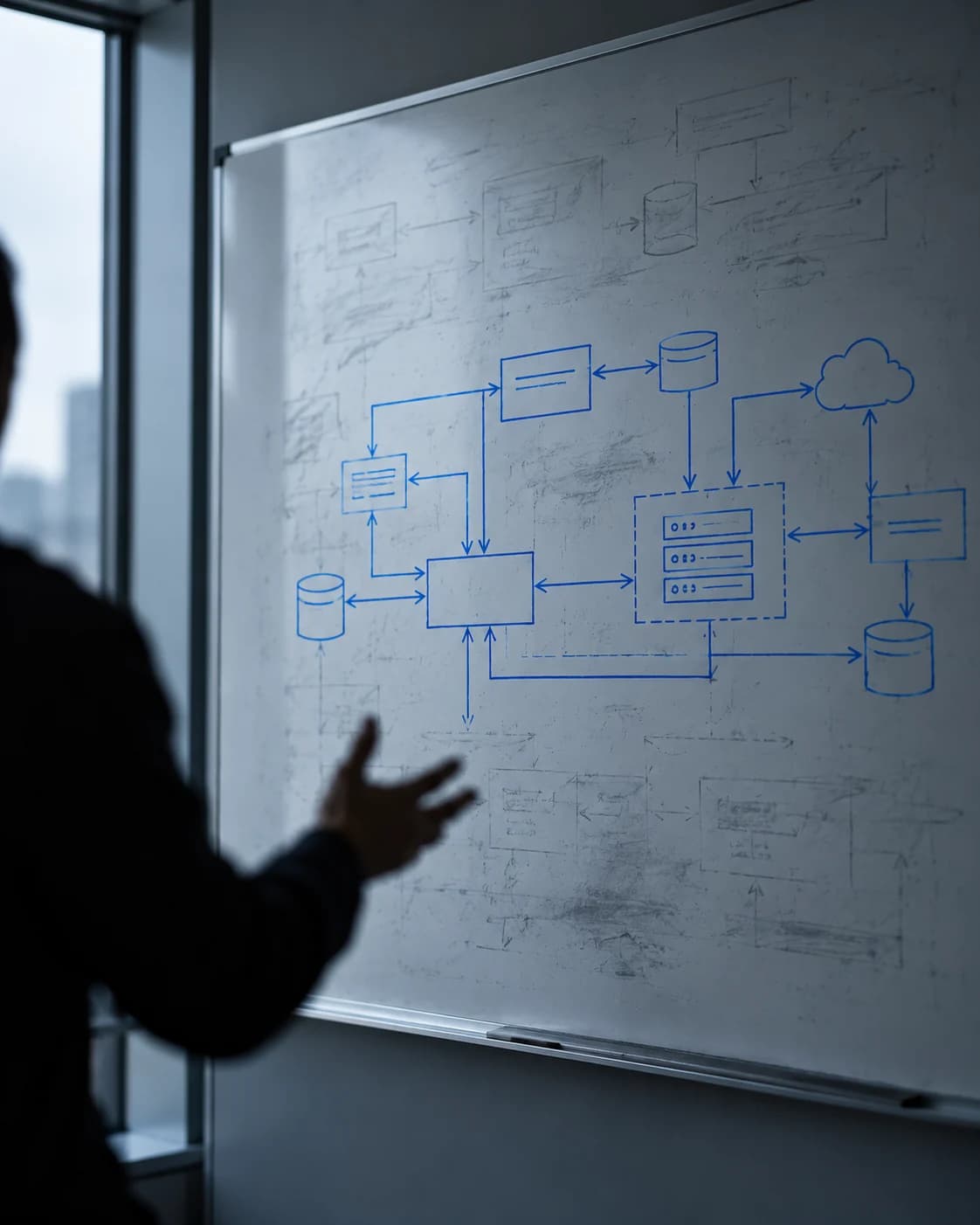
One team carries a decision from the whiteboard to the thing that is running and being operated.
Product Thinking
We focus on solving the underlying problem, not simply delivering tickets.
We push back on requirements that will cost more than they return, and we say so early.
How we build.
Five stages. Each produces something concrete — a decision, a design, working software — rather than a status update.
- 01
Understand
We work out what the system actually has to do, and what happens when it does not.
- Problem definition
- Constraints & risk
- Success criteria
- 02
Architect
Decisions that are expensive to reverse get made deliberately and written down.
- System design
- Data model
- Failure modes
- 03
Build
Vertical slices that work end to end, verified as they land rather than at the end.
- Incremental delivery
- Tests that matter
- Working software
- 04
Launch
Staged rollout with the instrumentation to tell whether it is going well.
- Progressive release
- Observability
- Rollback path
- 05
Scale
Performance, cost and reliability work driven by what production actually shows.
- Load & cost
- Hardening
- Iteration
On the portfolio.
The systems in our Work section are MaatX product demonstrations — engineered interfaces and architectures rather than client deployments. We build them because a working product communicates how we think far better than a capability list does.
They are not case studies and we will not present them as any. What they evidence is the part that cannot be faked: taking an unfamiliar domain, deciding how the system should be structured, and building something that runs.
- Company
- MaatX
- Domain
- maatx.xyz
- Focus
- AI · Blockchain · Software
- Model
- Engineering-led product work
- Scope
- Architecture → build → production
- Reach
- Globally oriented, remote-first
- Portfolio
- 201 interfaces across 17 systems
- Screens
- 24 switchable views
- Capabilities
- 85 distinct

Have something difficult to build?
Tell us what you’re building. We’ll help shape the product, the architecture and the path to production.