AI drafts the reply. A person still sends it.
A wrong answer to a customer costs more than a slow one. So the assistant produces a draft and the evidence behind it, automation is enabled per intent only once accuracy has been measured, and the blast radius of a mistake stays inside the team.
Why support automation gets switched off.
Most support AI is removed not because it was inaccurate on average, but because one confident wrong answer reached a customer and nobody could explain how. Every failure below is about containment rather than quality.
A wrong answer to a customer costs more than a slow one
Full autonomy on day one puts the worst case in front of the customer. The assistant drafts and a human sends, and automation is widened per intent only after sustained measured accuracy — so the cost of a mistake stays internal until the evidence justifies more.
The assistant needs real account data and becomes a data-leak path
An assistant with broader access than the agent using it is an exfiltration route. Tool calls are typed and scoped to the handling agent's own permissions, so it cannot read a record that person could not open, and every call is logged with its arguments.
Policies change and superseded versions read almost identically
Retrieval that treats all versions equally will cite last year's refund policy with total confidence. Recency weighting and supersession edges put the current policy first, and excluded passages are shown to the agent as excluded rather than silently dropped.
Confidence scores are meaningless unless calibrated
A raw model score is not comparable across intents. Thresholds are set per intent from a labelled evaluation set and recalibrated against agent edit and approval rates, so 0.85 means the same thing in billing as in orders.
Automatic CRM writes destroy trust the first time one is wrong
One bad overwrite and the team stops believing the record. Sync is field-level with a per-field threshold: below it the update queues for review, and a human override is never overwritten on a later run.
Nobody can tell whether the automation is actually helping
Without per-intent measurement, expansion decisions get made on the demo that went well. Deflection, edit rate, escalation reason and satisfaction are tracked per intent so the next intent to automate is chosen on evidence.
How we build one.
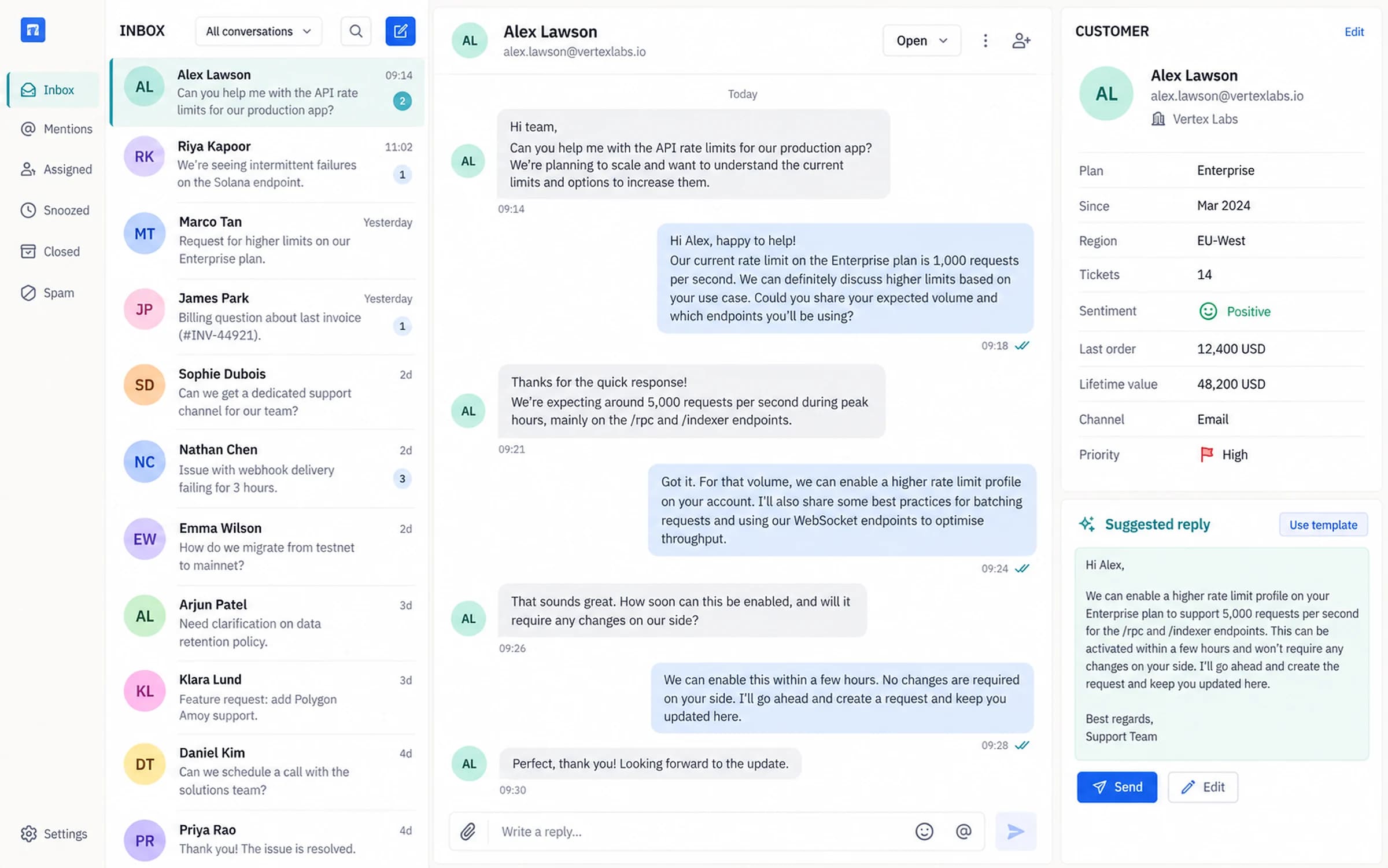
The assistant never talks to the customer directly. It produces a draft plus its evidence and a human decides, which is exactly what makes the automation safe to widen later.
- 01
Agent workspace
A unified inbox with the conversation, the customer context and the draft presented for approval or edit.
- Next.js
- Draft approval
- 02
Orchestration
Intent classification, retrieval, tool selection and confidence gating, deciding what the assistant may attempt at all.
- Intent routing
- Confidence gating
- 03
Knowledge layer
Hybrid retrieval over policies, macros and prior resolutions, with citations and supersession so the current answer wins.
- Hybrid retrieval
- Supersession edges
- 04
Tool layer
Typed, permissioned read and write calls into CRM, billing and order systems, scoped to the handling agent and fully logged.
- Typed tools
- Scoped permissions
- 05
Approval gate
Per-intent confidence thresholds with edit tracking and escalation routing, so widening automation is a measured decision.
- Per-intent thresholds
- Edit tracking
- 06
Systems of record
Bi-directional sync at field level with per-field confidence, so the record reflects what happened rather than what was guessed.
- Field-level sync
- Override-safe writes
We have already built this.
NOVA is our AI customer operations workspace: drafts grounded in retrieved policy with citations, typed tool calls scoped to the agent's own permissions, per-intent confidence thresholds with an approval gate, and field-level CRM sync that never overwrites a human edit. It is a MaatX demonstration rather than a client deployment, and the mechanisms above are running in it.
Questions we get asked.
Will this replace our support team?
No, and we would be sceptical of anyone promising it will. What changes is where the team spends its time: drafting and looking things up shrink, judgement and the hard conversations do not. Teams that treat it as a headcount reduction tend to switch it off within a quarter, because the first bad interaction has nobody accountable for it.
Can it ever answer customers directly?
Yes, per intent, once the evidence supports it. A narrow intent with high measured accuracy and a low cost of error — an order status lookup, say — is a reasonable candidate. A refund decision is not. Autonomy is widened one intent at a time against measured edit and escalation rates, not switched on globally.
What does it integrate with?
CRM, helpdesk, billing and subscription platforms, read and write. The constraint worth knowing is that every write is typed, scoped and logged — the assistant cannot take an action the handling agent lacks permission for, which is what keeps it auditable.
What does an engagement look like?
Discovery and Architecture first, where most of the value is deciding which intents are candidates for automation at all and what the threshold policy should be. That assessment is useful whether or not we build it.
What it costs, and what you are agreeing to.
The commercial answers in one place, so none of them has to wait for a call.
Typical route in
AI Engineering
Typically $25,000–120,000
Scoped per system
Retrieval that stays grounded, agents that are replayable, and evaluation that runs before anything ships. The model is one component with a contract, not the product.
A starting point for the scope described, not an estimate for your project. Ongoing engineering runs at $75 per hour blended.
Who owns what you build?
You do. On full payment of the fees for an engagement, the intellectual property in everything built specifically for you is assigned to you.
Our pre-existing tools, libraries and internal infrastructure stay ours — but where a deliverable uses them, you get a perpetual, worldwide licence to run, modify and extend it. Nothing we hand over needs us to keep operating it. Open-source and third-party components keep their own licences, and we tell you which ones and what they require.
We also will not name you as a client, describe your project, or publish a case study about it without your written agreement.
What happens if it does not work out?
Either of us can end an engagement with 30 days written notice, or immediately if the other commits a material breach and does not remedy it within 15 days. You pay for work properly performed up to that point, and we hand over completed work along with every deliverable you have paid for.
Two limits worth stating before you ask. We are engineers, not advisers: nothing we deliver is legal, regulatory, tax or financial advice, and a system built to your specification is not an opinion that it is lawful in your jurisdiction. And where our work includes reviewing or auditing code, the findings cover the scope and time agreed — an absence of findings is not a guarantee that nothing is there.
What do you need from me to start?
Not a specification. Discovery exists precisely because most people do not have one — an idea, or a technical problem you cannot yet size, is enough to begin.
What the work does assume: timely access to the people, systems, credentials and environments it touches; decisions and approvals at roughly the pace the timeline assumes, since delays on your side move both dates and cost; and that you have the right to give us whatever you give us, including data, code and third-party material.
Why you rather than the alternative?
Against hiring a senior engineer in-house: sourcing one takes months and commits you permanently. Discovery runs 1–3 weeks, and you keep the architecture whichever way you then go — including if the answer is to make that hire.
Against the cheapest contractor available: you will pay less per hour. Our argument is that the architecture decision is the one that is expensive to reverse, which is why we sell it first, separately, and at a price you can say yes to before committing to a build.
Against a larger firm: there is no account layer. The people who scope the work are the people who build it.
And when not to hire us: if a no-code or off-the-shelf tool still fits what you are doing, stay on it. We are worth paying once you have hit a ceiling you cannot engineer around from where you are.
These are summaries. The binding version of the ownership, exit and liability terms is in our Terms of Service. A person reads every enquiry. We usually reply within a few hours.
Start a technical assessment
Scaling customer operations without adding headcount, and keeping a human on the answers that matter?
Send us the architecture or the problem. We will come back with the technical risks we can see and a sensible path forward, free, and tell you if we are not the right people for it.